Beckman Institute Open House 2011
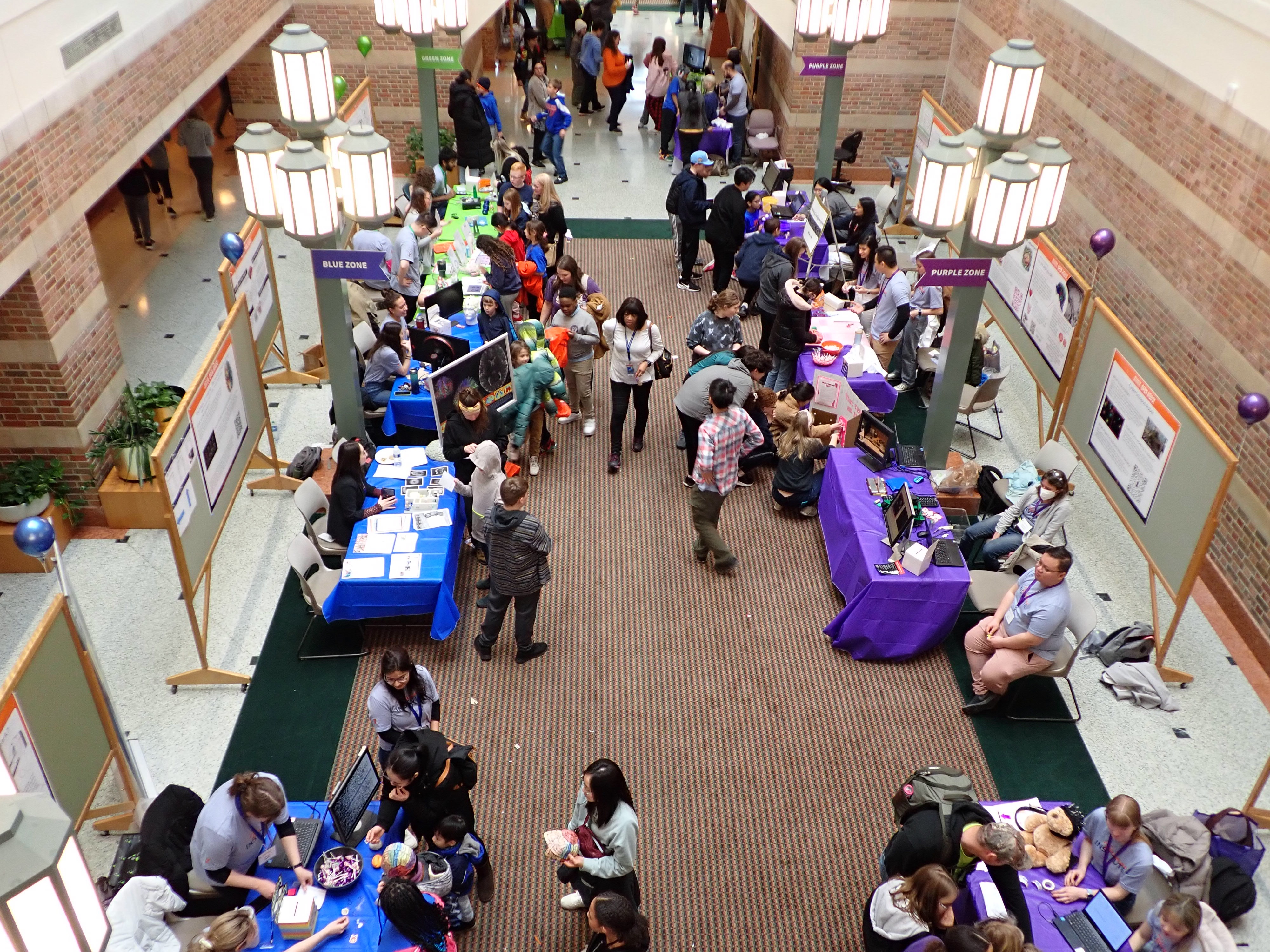
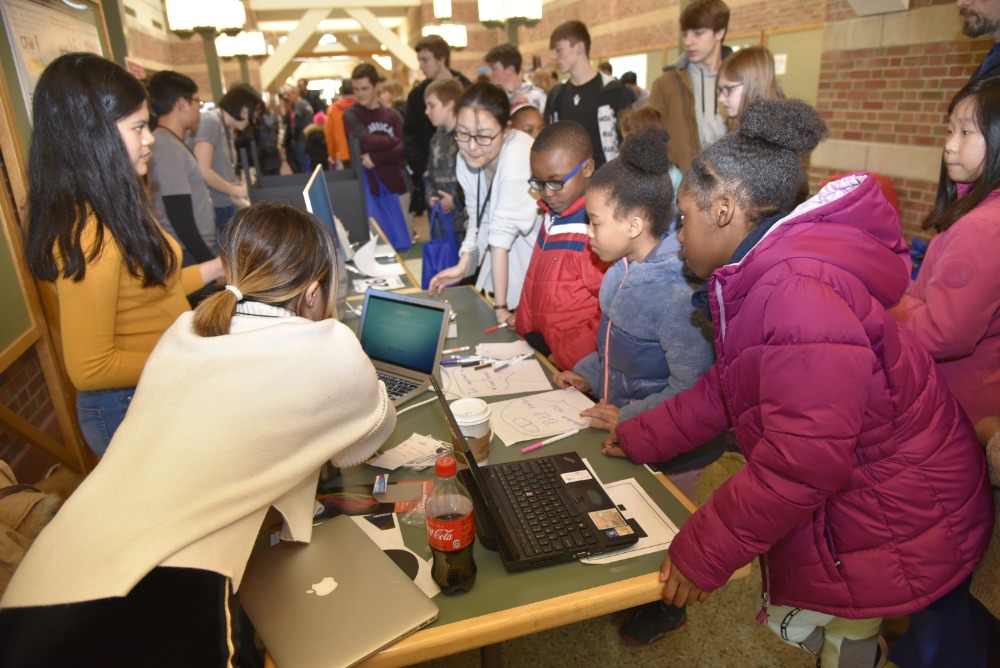
The Beckman Institute Open House is a biennial event, held in conjunction with the University of Illinois College of Engineering Open House. The Beckman Institute Open House features numerous exhibits showcasing fun and interesting research topics.

Friday, March 11 from 9:00 a.m. to 4:00 p.m.
Saturday, March 12 from 9:00 a.m. to 3:00 p.m.

The Beckman Institute is located on the University of Illinois campus at 405 North Mathews Avenue in Urbana, at the intersection of Mathews and University Avenue. Metered parking available in the parking deck across from the Institute. Schools, clubs, and other large groups are welcome.

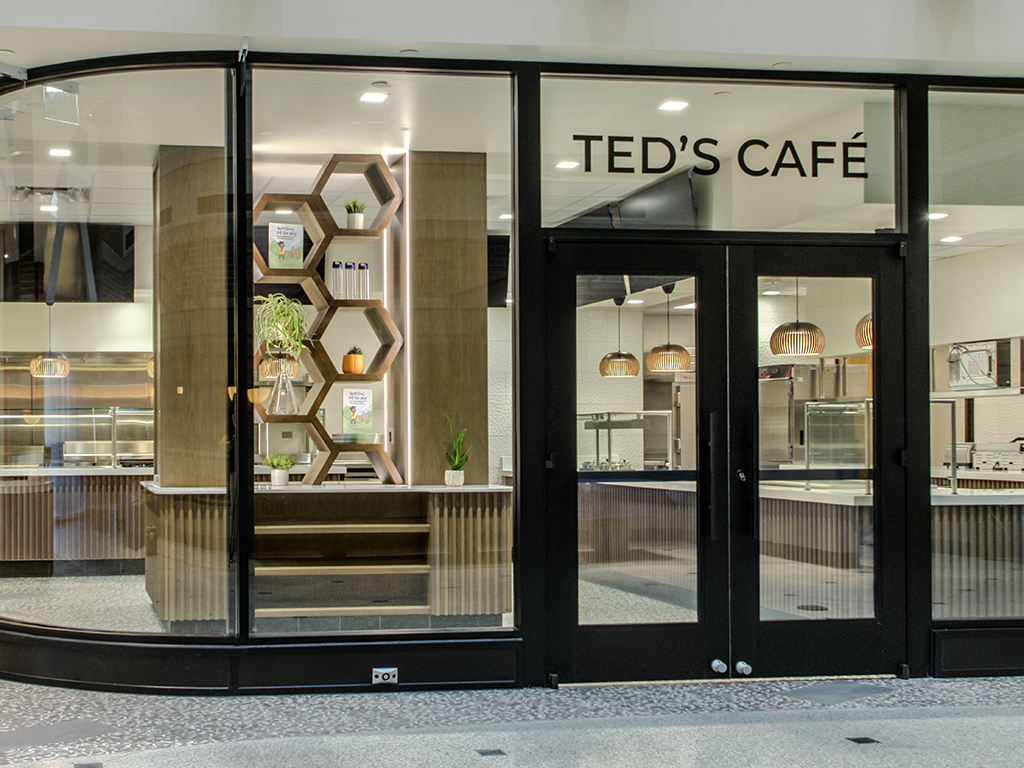
The Beckman Café will be serving breakfast and lunch and all of its menu items to visitors during both Open House days. Visit the Beckman Café »

Exhibits and Demonstrations

Beckman Open House Exhibits
Jump to Section: Atrium & 1st Floor, Basement, 2nd Floor, 3rd Floor, 4th Floor

ATRIUM & FIRST FLOOR

Bert, the Humanoid Robot • Room 1510

Come meet Bert, the Language Acquisition and Robotics Lab's humanoid robot. Our lab studies cognition by replicating the human developmental learning process on robots. Researchers will be demonstrating some of his latest learned skills.

Senior Odyssey • Atrium

Learn how Senior Odyssey engages adults over age 60 in a variety of problem-solving activities to better understand how we can maintain our cognitive vitality as we age.

Infrared and Raman Spectroscopy for Disease Diagnosis • Atrium

The exhibit will demonstrate the advances made towards developing infrared and Raman spectroscopy for disease diagnosis. Visitors will also have the opportunity to have thermal images of their heads taken with a special infrared camera!

Walking with Your Arms: Biomechanical Modeling of Wheelchair Propulsion • Room 1003

Professor Jacob Sosnoff and students demonstrate how motion capture is used to study wheelchair propulsion.

Illinois Simulator Laboratory • Room 1005

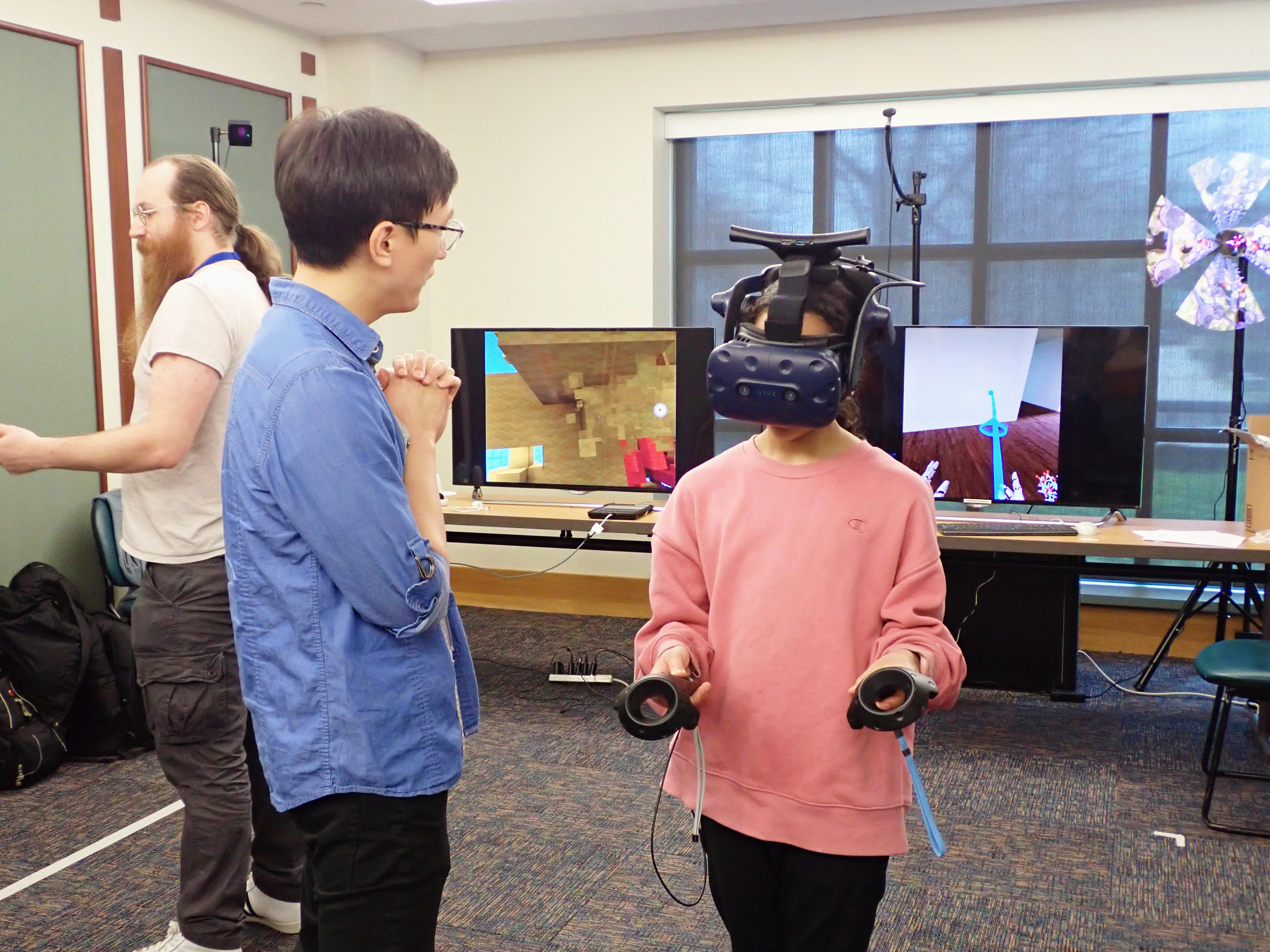
Back this year are the popular and renowned tools of the Illinois Simulator Laboratory! You will be able to see traveling versions of the CAVE, the Driving Simulator, and the Flight Simulator.

Audio Easter Egg Hunt • Room 1237

Join in an Audio Easter Egg Hunt and learn how Professor Mark Hasegawa-Johnson, BI researchers and students develop tools to visualize sound.

Imaging the Brain • Atrium

Visit this exhibit for an interactive demonstration of the optical imaging methods used in the Cognitive Neuroimgaing Lab. The demonstration includes a look at the Event Related Optical Signal (EROS) and its use in studying changes in brain activity and cognition.

Drugs of Abuse • Atrium

This exhibit will feature goggles that simulate intoxication with alcohol. Visitors can try on the goggles and attempt to shoot baskets to illustrate the impairment. The exhibit will also have a few items out on display that explain how they measure drug reward in animals.

Live Cell Imaging of Molecular Signals • Atrium

At this exhibit researchers will explain fluorescence technology including fluorescence resonance energy transfer applied to develop molecular biosensors and monitor signaling events in live cells with high spatiotemporal resolutions.

Imaging at Illinois • Atrium

Learn about all the wonderful ways imaging is pervasive in today's society. We will enable you to take a picture of yourself and then digitize that image with other images using a keyword as your choice.

A Journey through the Molecules of Life: See the Insides of a Virus • Atrium

Living matter follows the same laws of nature as inanimate matter. The amazing complexity of life is engrained in the ingredient molecules and their myriad interactions, forming elaborate machines. We will take a close look at two such biological machines: a virus and a photosynthetic organelle. The former is the cause of infectious diseases, while the latter is a source of energy for living beings. We will see these two distinct examples from the kingdom of life at a level of detail showing the individual atoms they are made of as well as their inner organization.

Hands-free Gaming and 3D Face Tracking • Atrium

At this exhibit researchers will demonstrate the application for video gaming of our 3D face modeling and tracking system. The system gives users the ability to control a video game by their face movements and expressions. The demo can run real time and totally hands-free on a typical desktop PC.

De-stigmatizing Assistive Technology: Hearing Aids • Atrium

This exhibit will illustrate the designing process that de-stigmatizes products for people with disabilities, with particular emphasis on hearing aids.

Teaching Mathematics through Form and Braille • Atrium

This exhibit will illustrate how mathematics can be integrated into tactile sculptures to encourage children with visual impairments to explore mathematics through an alternative format. The designing process will be on display and the designer will be present to discuss the approach and philosophy of the project.

Medtable: An Electronic Medical Record (EMR) Strategy to Promote Patient Medication Understanding and Use • Atrium

Visit this exhibit to learn about Medtable, a tool developed to improve patient/provider communication, patient knowledge, and appropriate use of complex medication regimes for patients with type 2 diabetes. The use of the Medtable will be demonstrated and researchers will provide more information about the aims and status of their study.

NCN@Illinois • Atrium

Visit the Network for Computational Nanotechnology's exhibit to learn about their mission to connect theory, experiment, and computation in a way that makes a difference to the future of nanotechnology. While addressing challenges in nanotechnology, NCN researchers produce new algorithms, approaches, and software tools with capabilities not yet available commercially. As part of the NSF's infrastructure for the National Nanotechnology Initiative, the NCN engages the community through workshops and seminars and novel educational resources. You can also learn about online research and educational tools that they create which can be viewed for free by anyone in the world with an internet connection.

The Intonation Station • Atrium

Intonation is the music of speech. It can turn a declaration into a denial, an inquiry into an inquest, and generally change the meaning of a phrase without changing a single word. Intonation is vital in all forms of speech communication, in all languages, and can reveal chapters about a speaker's linguistic history. But what exactly is intonation and how do we exploit it to convey meaning in speech? At this exhibit, you will see how linguists and engineers investigate intonation using acoustic signal processing and how computer systems can automatically track intonation for human-computer dialogue. Then try your hand at the Intonation Station where you can customize intonation with synthesized speech and craft an intonational style all your own.

Seeing Two-faced Faces: Visual Perception of Ambiguous Figures • Atrium

In this demo, you will be presented with pairs of identical ambiguous figures and you will be asked to try to see different interpretations of the two figures at the same time. Even with intentional effort, many observers cannot hold opposing interpretations of the two figures in mind. However, when we provide a semantic relationship between the figures, observers can instantaneously see the two different interpretations. Until now, ducks and bunnies, old and young women, and vases and faces kept to themselves. Here we show how, with a single word, normally conflicting interpretations can peacefully exist side by side.

How Fast Can You See a Scene? • Atrium

People are remarkably fast at recognizing real world scenes. This demonstration will allow you to measure how quickly you can recognize photographs of real world scenes. You will also be able to experience how changes to the photographs make this much more difficult. Our group studies how the brain represents the world around us. Understanding how people can do tasks like this – and what changes make them harder – tells us what information the brain is using to recognize scenes.

Brain Plasticity: How it Works • Atrium

This exhibit will give you an overview of learning and memory mechanisms and also of adaptive changes in the brain during this process. The exhibit will include posters and slides depicting current brain research and a game demonstrating cerebellar learning.

Illuminating the Mysterious Inner Lives of Cells • Atrium

Cells, the building blocks of life, are extremely small and transparent and are thus very difficult to study. This interactive exhibit will guide visitors through the physics and principles of the techniques required in using light microscopy to study living cells. Furthermore, 3D movies acquired in our lab will be displayed to illustrate the power of using light to reveal the secrets of the inner lives of cells.

Neural Mechanisms Underlying Emotion-cognition Interactions in Healthy and Clinical Groups • Atrium

Researchers will show examples of the tasks and stimuli that they use to study neural mechanisms underlying emotion-cognition interactions.

Creating, Manipulating, and Visualizing Nanomaterials Using STM • Atrium

Have you ever wondered how things look at the atomic scale? Do you wonder what the big deal is about graphene, the topic of last year's Nobel Prize in physics? Using a Scanning Tunneling Microscope (STM), you can image very small features that are more than 100,000 times thinner than your hair! In the STM group, you can learn about nanoscience and technology by assembling nanoscale particles and even atoms, and manipulating them on various semiconductor surfaces. Imaging the nanoparticles like carbon nanotubes and graphene allows us to better understand the electronic properties and physics at the nanoscale.

What Would Dr. Seuss Say? People and Environment Today • Atrium

Visit this exhibit to learn how human uses of natural resources shapes the environment and, in turn, how environmental change is affecting the wellbeing and survival of populations around the world. Test your knowledge about the food, water, land, and fuel we all consume, where they come from, and how quickly we may be depleting or regenerating them. At the Social Dimensions of Environmental Policy (SDEP) exhibit, you will learn how people interact with and use their environment in places like India, Bhutan, Senegal, and Tanzania. Do people from different cultures and backgrounds use resources differently? Why? Do we all have equal rights and access to the resources we need? Why or why not?

Biomedical Imaging Center • Room 1215

At this exhibit one will see demonstrations of research projects conducted in a full size mock (no magnetic field) MRI machine. You will also experience hands-on operation of computer programs used for our research evaluation. New in 2011…see demonstrations of 2D ultrasound imaging!

Fun with Audio and Video Processing • Room 1714A

Visit this exhibit to see demonstrations projects showcasing audio and visual processing, including: Theremins, an electronic music instrument; Autotune and pitch shifting; and Visual pong, 3D Sound recording on a microphone array.

Seeing Speech • Room 1534

Human are masters of the art of speech production, being able to talk without consciously controlling the fast and intricate movements involved.  This exhibition takes you through a tour behind the screen to see how we coordinate speech movement, breathing and auditory feedback during speech production. Research on speech movement helps us understand speech production, speech disorder, second language learning, and to improve speech technologies.

Computer Vision and Robotics Laboratory • Office 1532

Showcase of research going on in the lab including: optical illusions and what they tell Us, 3D
reconstruction from video of Beckman and buildings on campus, mobile imaging platforms, automatic train inspection that is keeping you safe, and more...

Picture Yourself … with Beckman Research! • Outside Room 1005

Put yourself in the Beckman Institute research picture by stopping by this photo booth. Using Photo Booth technology, cool images from Beckman research, and the element of spontaneity provided by you and your friends, our Open House test subjects, err … visitors, we will take a snapshot of you for our “experiment” and report the results (our theory is that you will have fun) in a souvenir picture printout that is suitable for peer review.

Memory & Amnesia • Atrium

Profound memory impairment is a rare disorder that has greatly improved our understanding of how human memory functions. Join us for a presentation about the nature of amnesia and our lab's research into this fascinating condition.

BASEMENT

Microscopy Suite • B604/B606 & Atrium

This year the Microscopy Suite is featuring 1) our Fluorescence Microscope, which allows us to collect (and tile in x, y, and z) beautiful images of samples with multiple fluorescent labels; 2) our X-Ray Micro-Computed Tomography systems, which let us collect 3D images of opaque structures, allowing us to view their inner details; and 3) our Scanning Electron Microscope (SEM), which gives us high-resolution images of the surfaces of 3D samples, from nanotubes to silicon structures to insects. The SEM is the microscope we use for Bugscope, our K-12 Remote Microscopy Outreach program.

14.1T Inova Microimaging Scanner • Room B660 (only available at select times)

Official demos at 9, 10 & 11AM and 1 and 2PM; walk-ins welcome at any time
Visiting 14.1T (141000 Gauss) Inova 600 microimaging system you will see a super high magnetic field MRI scanner which is one of only seven such magnets in operation in the world. The instrument is capable of performing MR imaging and local microspectroscopic measurements with an imaging resolution up to 10 microns. You will get fascinating noninvasive MRI inside into a wide variety of alive subjects ranging from ants, caterpillars, sticklebacks and frogs to mice brain microstructure.

Molecular Imaging Laboratory • Room B668

Official demos at 9, 10 & 11AM and 1 and 2PM; walk-ins welcome at any time
New in 2011! Visit the newly constructed NSF-funded state-of-the-art Molecular Imaging Laboratory equipped with a tri-modality (PET/SPECT/CT) non-invasive imaging system. We will demonstrate the operating principles of the new imaging system, and how new imaging agents are synthesized in our radiochemistry laboratory. You will even get a chance to see some of our imaged animal specimen.

SECOND FLOOR

Language and the Brain • Lab 2438

As you read these words (or hear them being read to you!), your brain is engaged in the amazingly complex task of understanding language. Come see how researchers measure electrical signals from the brain using non-invasive EEG techniques, in order to explore this fascinating process of language comprehension.

Playing Checkers with your Mind • Office 2440

At this exhibit you will see a novel application for using a Brain-Computer Interface (BCI) based on Steady-State Visually Evoked Potentials (SSVEP) to play a game of checkers with a robot arm. Researchers will show how BCIs like this can be used to interact with the physical world by simply focusing on a blinking light.

Remote Teleoperation of an Unmanned Aircraft with a Brain-Machine Interface •
Room 2508 & Atrium

At this exhibit you can check out an interface that enables a human pilot to remotely teleoperate an unmanned aircraft with input only from an electroencephalograph (EEG). You will see the technology that recently made it possible for a human pilot connected to the EEG sensor in Beckman to fly an unmanned aircraft over a field many miles away using only their brain.

THIRD FLOOR

Autonomic Materials – Self-healing and Mechanoresponsive Polymers • Room 3712 & Atrium

In biological systems, external environmental factors trigger autonomic responses to maintain temperature, to sense and heal damage, and to promote system balance. Drawing from this inspiration, we have developed a self-healing polymer, a polymer that changes color in response to stretching and compression, and an electronic circuit in which conductivity is restored upon mechanical damage. These systems enable self-repair, eliminate costly replacement, increase the material lifespan, and provide users with a visual indication of damage before a catastrophic failure occurs. This display features videos and interactive demonstrations of self-healing polymers* containing microcapsules and microvascular** networks, a new series of mechanically active polymers*** that change color in response to load, and circuits in which conductivity is restored after scratch damage.
* Popular Science Top 10 Scientific Breakthroughs, 2001
** Scientific American 50 Award, 2007
***Popular Science 10 Tech Concepts for 2011

Finding Nemo Changing Sex • Room 3612 & Atrium

In the Atrium visitors will see a fish tank with two clownfish. In Lab 3612 tours will be given of the Marine Biology lab that includes numerous tanks with clown fish. Visitors will learn how these fish change sex depending on the social environment and make connections will be made with the popular Disney movie Finding Nemo.

FOURTH FLOOR

The Visualization Laboratory • Room 4602

The Imaging Technology Group provides the Beckman Institute, the University of Illinois, and other organizations with a wide variety of imaging, microscopy, and visualization resources. Come learn about the work (and fun!) that happens inside the Visualization Laboratory and discover the amazing world of imaging technology. See live demos of 3D data visualization and animations, high-resolution photography, ultra-high-speed video, multi-color 3D printing, and much much more!