Exhibits and Demonstrations
Basement
Imaging Technology Group: Microscopy Suite - Basement Room B606
Visit the Microscopy Suite and you will see demonstrations of the confocal microscope, the fluorescence microscope, and the micro and nano-computed tomography systems. And you can check out the environmental scanning electron microscope which is used for our popular Bugscope program. You'll even get to tour some of our insect samples via the microscope.
First Floor
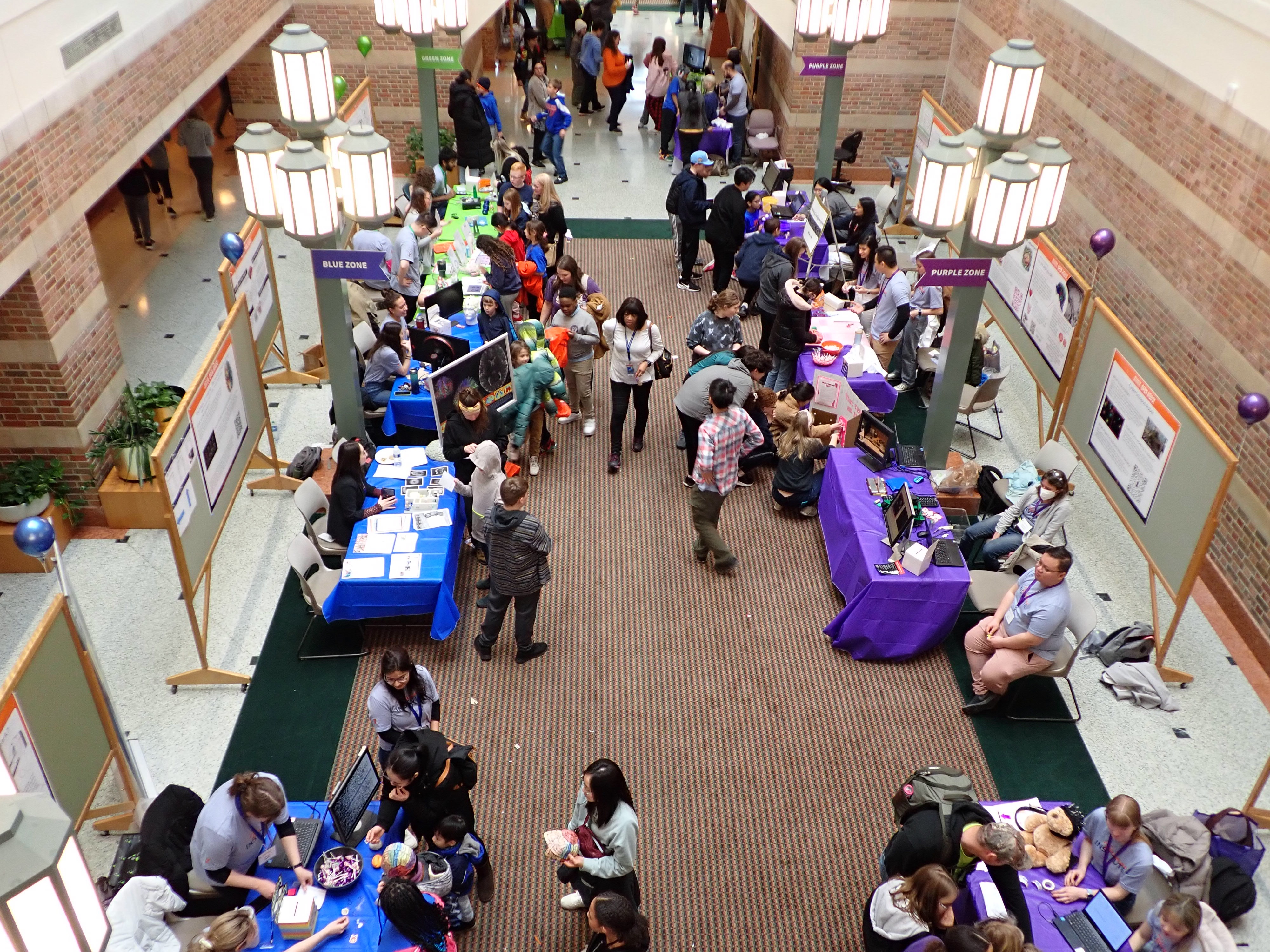
Human Speech Perception - Atrium
Visit this exhibit to learn how humans decode speech sounds using examples where researchers have modified basic speech sounds, so that one sounds like another.
Power Dissipation and Heat Transport in Dimensionally Mismatched Materials and Devices - Atrium
Reducing power dissipation is a fundamental challenge for continued scaling of nanoelectronics. A possible solution is to introduce novel, high mobility/high thermal conductivity materials as devices, interconnects, or back-end heat sinks. Among these, carbon nanotubes (CNTs) and graphene are materials with extraordinary electrical and thermal properties. This exhibit will show you how they are exploring the fundamental behavior of these types of dimensionally mismatched devices and thermal-electrical materials, and applying that knowledge in the design of nanoscale electronic devices.
Ultrasound Imaging - Atrium
This group will demonstrate typical 2D ultrasound imaging techniques including B-mode, color flow, and Doppler. A video demonstration of elastography will also be included as an example of advanced ultrasound applications.
Disability + Relevant Design - Atrium
Check out a new kiosk that supports new program development by eliciting user feedback and comments.
Senior Odyssey - Atrium
Learn how Senior Odyssey engages adults over age 60 in a variety of problem-solving activities to better understand how we can maintain our cognitive vitality as we age.
Imaging the Brain - Atrium
Visit this exhibit for an interactive demonstration of the optical imaging methods used in the Cognitive Neuroimgaing Lab. The demonstration includes a look at the Event Related Optical Signal (EROS) and its use in studying changes in brain activity and cognition.
A Journey Through Molecules of Life with Your Friendly Neighborhood Biophysicist - Atrium
This improvised show will introduce the audience to the fascinating world of proteins, their structures, adventures, dances, and romances, using computer-generated graphics.
Human-Computer Interaction - Atrium
See computer demonstrations that can perform gender recognition and age estimation, person detection and height estimation, and 3D face generation from 2D face images.
Universal Access Project: Voice-Typing Game - Atrium
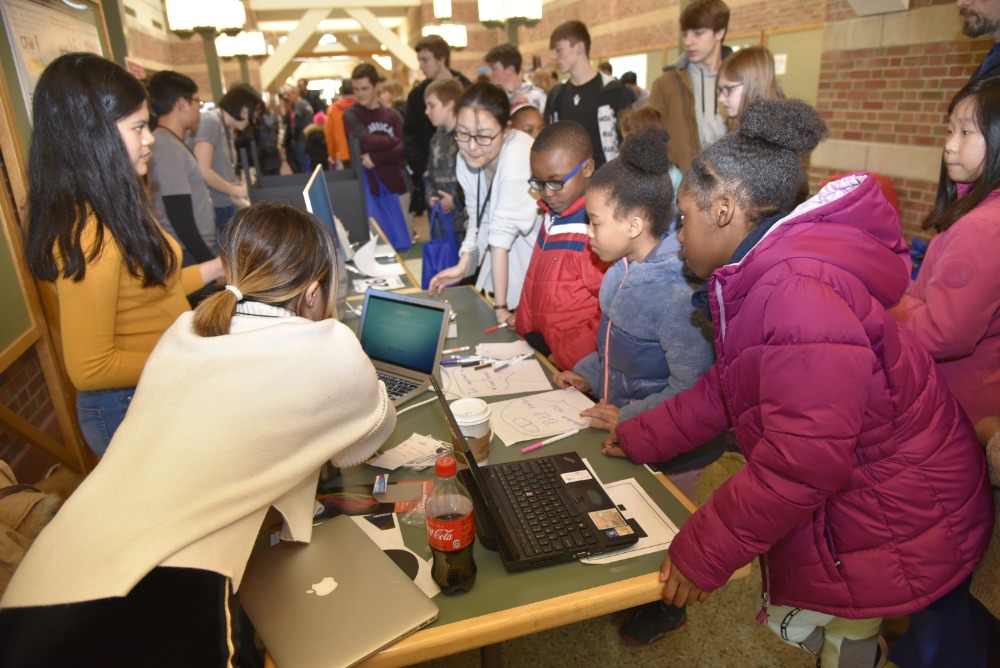
In its Universal Access Project, this research group has been developing speech recognition models that will enable people (including people with a speech disorder) to enter unrestricted text into a personal computer via automatic speech recognizer. At this exhibit you can see an interactive demonstration of a voice-typing game on a PC.
Alcoholism and Drug Abuse - Atrium
Participants try to shoot a basket while wearing goggles that simulate alcohol intoxication. We will also have a preserved mouse brain for people to look at and we will show equipment used in our laboratory to measure preference for drugs in mice.
Visualizing and Manipulating Atoms - Atrium
Ever want to write your name in atoms? In the STM lab, you can learn about nanoscale science, imaging carbon nanotubes and graphene, using a scanning tunneling microscope to look at atoms and surfaces, self-assembly of nanoscale spheres, computer chip lifetime improvement using deuterium, and advances being made to make computers faster.
The Curious Case of Our Changing Brain - Atrium
This exhibit will give you an overview of learning/memory and adaptive changes in the brain during this process. The exhibit will include posters and slides depicting current brain research and a game demonstrating cerebellar learning.
nanoHUB - Atrium
What is nanoHUB and how does it work? Stop by this exhibit to learn about a new cyberinfrastructure for sharing ideas and tools.
iMed - Improving the Medication Scheduling Task for Older Adults - Atrium
The exhibit show the development of the iMed and the related research that influenced the design. You can also take part in a demo that allows you to interact with the iMed and try to successfully schedule a sample medication problem.
Infrared Spectroscopic Imaging for Pathological Determination of Human Tissues - Atrium
Fourier Transform Infrared (FTIR) spectroscopic imaging has emerged as a potential route to objectively characterize a specimen based on its chemical composition. FTIR imaging utilizes the unique absorbance of infrared radiation by specific molecular vibrational modes to obtain quantitative optical signatures that are characteristic of the sample. By developing a modified Bayesian classification system for colon tissue, this exhibit will show you how they are working to develop a robust paradigm for diagnosing colon cancer that would provide a chemical-level assessment of tissue.
Tactile Captions for Math and Science - Atrium
This exhibit will show you how researchers are working to create more universal visio-tactile methods for captioning physical sculptures from mathematical and scientific computing. These objects provide access to STEM information for people with visual impairments and certain cognitive learning disabilities. The result will be lower barriers to STEM careers and greater inclusion in STEM for significantly large populations who might not otherwise consider the possibility.
Large Bone Defect Repair by Regeneration in Adult Xenopus laevis Hind Limbs - Atrium
Learn how researchers are studying and screening bone scaffold growth and how it can be used in bone repair by regeneration. Exhibitors will show you the results of a six week trial.
Quantitative Light Imaging - Atrium
Stop by this exhibit to see video demonstrations of quantitative live cells (e.g. neurons and beating heart cells) imaging and. The researchers will also be showing new techniques in nanometer resolution and how they are making the nano-world more accessible.
Biomedical Imaging Center - Room 1215
At this exhibit you will see demonstrations of research projects conducted in a full size mock (no magnetic field) MRI machine. You will also get to experience hands-on operation of computer programs used for research evaluation.
A 3-D Journey Through Molecules of Life: Photosynthesis - Room 1227 (only available at select times)
Life on Earth is sustained by photosynthesis, where many proteins cooperate to harvest the energy of sunlight. In this show, researchers will show you a close, 3-D look at these molecules of life and how they function.
Slips of the Tongue: Beyond Freud - Room 1412
What do slips of the tongue tell us about the mind? Freud thought that they reveal the unconscious, but it turns out that they tell us more about how we retrieve words than wishes. This lab will present a variety of demonstrations to show how we can use normal speech errors, as well as those made by patients with brain damage, in the scientific study of human language.
Robot Learns Grammar and Talks - Room 1510
Our anthropomorphic robot Illy wanders around his playpen moving objects and explaining his activities.
Research at the Computer Vision and Robotics Laboratory - Room 1520
Stop by this lab to see a showcase of the research conducted in our lab in the field of computer vision including painter classification from painting style analysis, dynamic texture synthesis, automatic depth perception, human action recognition, etc. Researchers will also show you their computer vision technology which is used for automatic train inspection. You can explore their face detection booth for incoming guests.
Seeing Speech - Room 1534
Speech is a very effective communication system. We as human are masters of the art of speech production, being able to talk without consciously thinking about controlling and coordinating the fast and intricate movement involved. This exhibit uses the Electromagnetic Articulograph AG500 (EMA) system in the Speech Dynamics Lab to demonstrate speech movement, allowing you to see the movement of the articulators, such as the lips and the tongue, during speech production. Research works on speech movement help us to understand speech production, speech disorder and second language learning, and to improve speech technologies.
DNA Nanotechnology and Its Environmental and Medical Applications - Room 1710
This group has developed patented functional DNA nanotechnology by combining functional DNA with nanomaterials such as gold and iron oxide nanoparticles. This technology has resulted in a number of simple, colorimetric sensors for lead, mercury, uranium cocaine and many other toxic chemicals and biologicals (such as bacteria and viruses) in the environment and in medical diagnostics. Learn how dipstick tests of these targets can be used in household applications. You can also learn how an extension of this technology is being used to develop smart contract agents in magnetic resonance imaging (MRI) of markers for human diseases such as cancer.
Second Floor
Language and the Brain - Room 2438
As you read these words (or hear them being read to you!), your brain is engaged in the amazingly complex task of understanding language. Come see how researchers measure electrical signals from the brain using non-invasive EEG techniques, in order to explore the fascinating process of language comprehension.
EEG-based Brain Computer Interface - Room 2440
This exhibit showcases examples of Brain Computer Interface (BCI) based on Electro-encephalogram (EEG) signals acquired on the skull. This BCI enables the user to use her/his brain wave to spell out sentences in English, or specify a curvy path in a 2D space. There are a lot more cool applications that we can think about in the future.
Third Floor
Optical Coherence Tomography: Seeing Under the Skin - Room 3412
Visit this exhibit to see a real-time interactive demonstration of Optical Coherence tomography that looks under the skin. Researchers will also explain biomedical applications of Optical Coherence Tomography.
Self-Healing Materials and Autonomous Systems - Room 3712
Living organisms have the ability to heal from injury, an ability not shared by simple materials. This lab has developed general methods to create polymers that can independently heal from damage. Firstly, materials containing embedded capsules with active components, and secondly, microvascular systems that have synthetic versions of blood vessels to carry healing agents. This exhibit has demonstrations of both of these systems, live experiments showing capsule release after material cracking and blacklight imaging of a microvascular network in a material. You can also watch a video demonstration of healing samples.
Fourth Floor
Imaging Technology Group: Visualization Laboratory - Room 4602
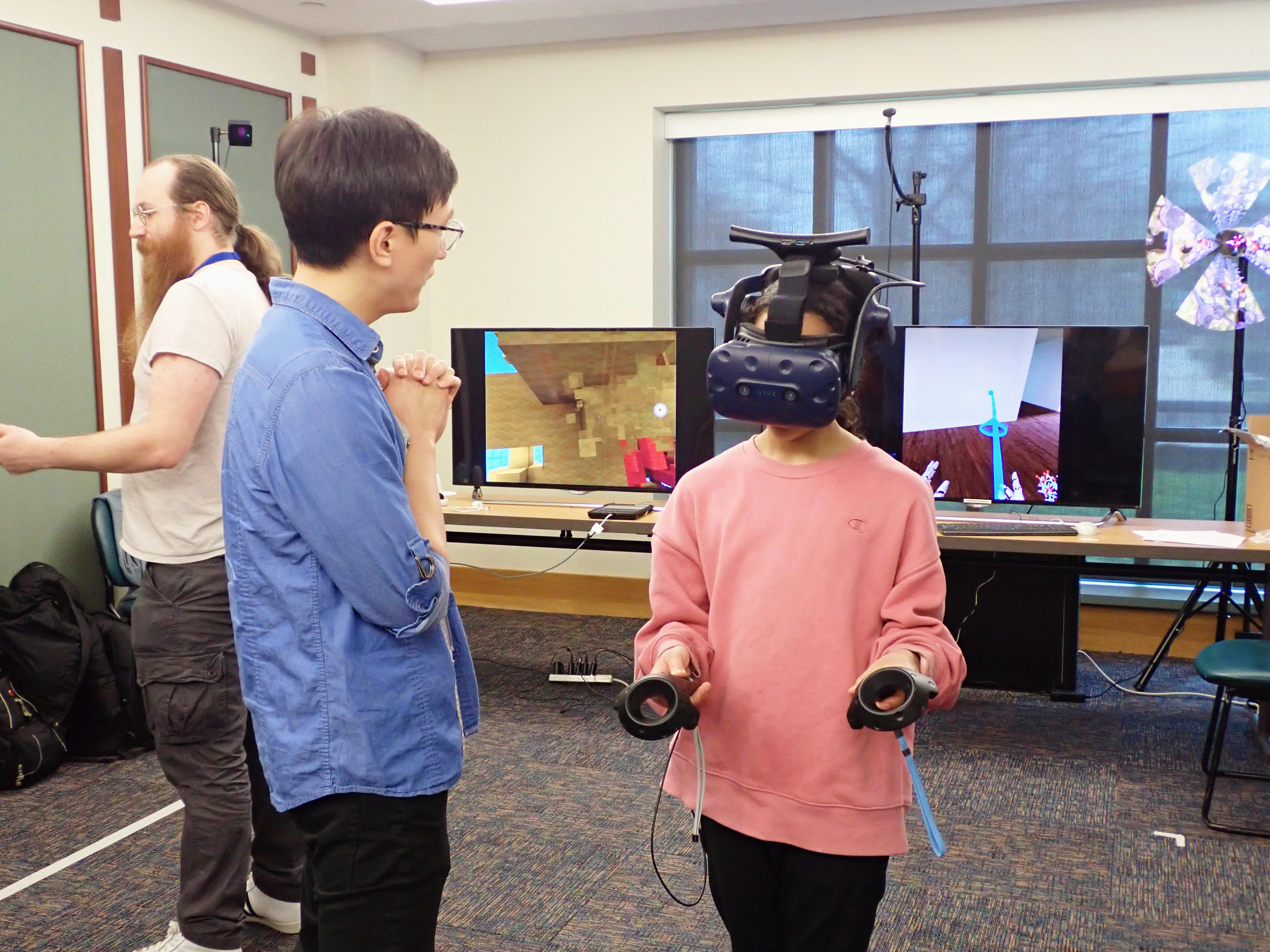
Visit the ITG Visualization Laboratory to see fascinating demonstrations of scientific visualization methods. See how scientists use various kinds of visualization including: 2D/3D/4D image analysis, 3D printing, 3D modeling and animations, 3D laser scanning, macro-photography, high-definition video, and other imaging capabilities.